Generative Business Intelligence
Business users often get lost in standard reports and dashboards. Even when finding the required data point, they often have follow up questions requiring a data analyst.
Generative Business Intelligence (GenBI), allows us to tighten this loop by building a semantic model on top of your data enabling an AI agent to understand your business context. This allows any business user to ask questions in plain language and get reliable answers while lowering the barrier for self-service analytics.

A new kind of chaos
For decades, the goal of Business Intelligence has been to empower organizations with data-driven decision-making. Yet, despite massive investments in sophisticated toolsets, a significant gap remains between having data and using it effectively.

Business users struggle to find their way
Most BI organizations maintain a large library of standard reports and dashboards. Navigating this landscape is often complex: users must know which reports are still relevant, which are outdated, and which ones actually answer their specific business questions.

Static reports limit exploration and insight
Dashboards work well for standard metrics, but finding answers to new questions means navigating multiple reports, filters, and tabs. Many give up before they find what they need—or discover it hasn't been built yet.

Limited capacity of data analysts
Data analyst capacity is scarce and should be focused on high-impact, strategic work. Instead, analysts are often consumed by repetitive, reactive, fragmented business questions
Talking to your data
We build a semantic model and connect it to an AI agent for natural language data interaction. Whether you're on Snowflake, Databricks, or another platform, we work with tools like Cortex Agent, Genie, or Wobby, whatever fits your environment.
A semantic layer that captures business meaning
We define relationships between data entities, business measures, and the custom calculations your teams actually use.
A shared vocabulary between business and data
We add synonyms and glossary items so the agent understands that 'churn,' 'customer attrition,' and 'klantverloop' mean the same thing, but that 'cancellation' doesn't. Business language maps directly to technical data structures.
A conversational interface, not just Q&A
Users can chat with the agent, ask follow-up questions, and drill deeper. The agent explains its reasoning and provides context—helping users explore until they find exactly what they need.
Built-in guardrails
The agent knows its limits. When data isn't available or a question is too complex, it tells the user clearly and directs them to the data team, ensuring consistent, trustworthy answers.
Results
Reduced time-to-insight
From days waiting for analyst availability to minutes of self-service querying. Also the semantic model ensures everyone works from the same definitions and calculations

Freed-up analyst capacity
Less time on repetitive ad-hoc requests, more time enabling strategic data initiatives

Higher data adoption
Lower barrier means more people use data to drive their decisions
Powered by Datashift’s expertise

.png)

Data & AI Strategy

Data governance

Data engineering

Business analytics

Data Science & AI
.svg)
Data Compliance
How we solved this for our clients
We deliver impact where it matters most.



Keep reading
Eager to learn more? No worries: we’ve got you covered.
.png)
Data Products Need Funding. Not Projects.
Your data product strategy is not failing because of your technology. It is not failing because of your talent. It is hitting a wall because you are trying to run a product organisation on a project budget. These two models are fundamentally incompatible.

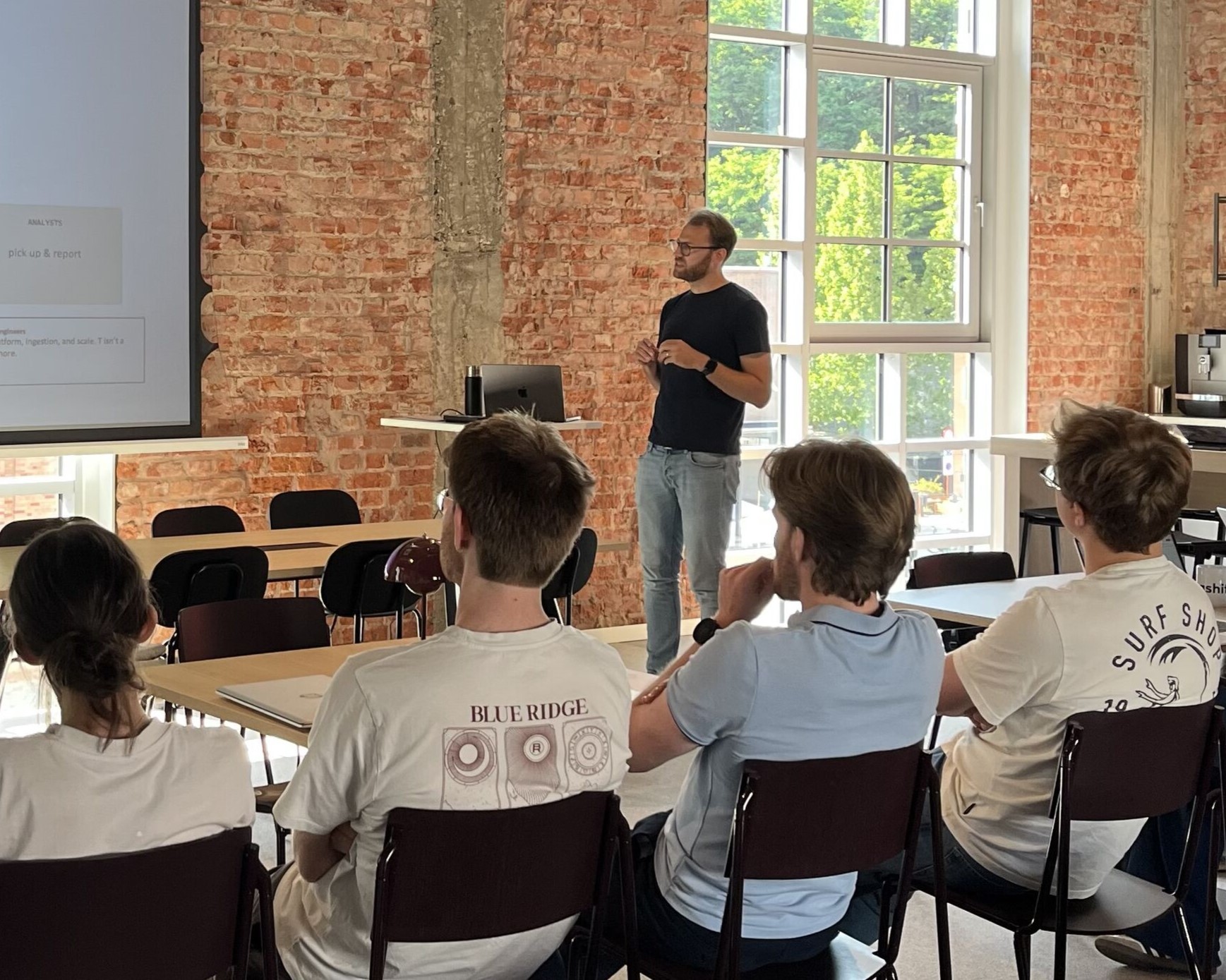
From Messy Documents to Governed Knowledge: What Our Hackathon Revealed About AI Agents
Most of an organization's knowledge lives outside structured systems: slide decks, meeting notes, contracts, feedback forms, and old project folders. This knowledge was the focus of a recent Datashift hackathon.

.png)
Centralized or Decentralized? Building a Silver Layer that does both with dbt
Most data teams are stuck choosing between consistency and speed: central control brings governance but creates bottlenecks, while domain ownership brings agility but leads to chaos. This blog explores a hybrid Silver layer that delivers both, using dbt as the framework to make it work.
.jpg)