Data Governance Engineering: Making Governance Invisible


Introduction: Governance That Moves at the Speed of Insight
"Good governance shouldn't slow you down; it should help you move faster with confidence." This is the work philosophy of Arnaud Gueulette, a Data Governance Engineer at Datashift. Datashift's teams help their clients show that governance doesn't have to be a roadblock. Instead, it can be the invisible backbone that enables agility, compliance, and collaboration, but without the friction.
For teams using platforms such as Snowflake, AWS, or Collibra, this approach provides a blueprint for integrating governance seamlessly into operations. The methods focus on automation, Shift-Left principles, system thinking, and human-centric design, ensuring data remains reliable, compliant, and easy to use.
What Is Data (Governance) Engineering?
Data Governance Engineering is about designing systems where governance feels like a natural part of the workflow.
Core Principles:
- Governance by default (shift-left): Detect issues in CI/CD before production ever sees them. "I embed governance into pipelines from day one, so compliance becomes automatic." Arnaud uses Terraform and Terragrunt (IaC) to deploy platforms like Collibra DQ and Edge, ensuring governance rules are version-controlled, tagged and baked into infrastructure from the start.
- Practical Automation: "If it's repetitive, automate it." Using tools like AWS Event Bridge and Lambda, Arnaud builds event-driven workflows that handle metadata updates, trigger validations, and sync governance states across platforms without manual intervention.
- Shift-Left Governance: "Catching issues early saves time and headaches." By integrating governance checks directly into CI/CD pipelines, teams catch misconfigurations and policy violations before they break deployments; not after they reach production.
"The tools we have today are powerful, but the real magic happens when we use them to support the team."
Model Context Protocol: Governance That Comes to You
Embedding governance early, automating the repetitive, making complexity invisible; this all points toward the same goal: governance that doesn't interrupt flow. Recently, that vision found a new expression through the Model Context Protocol (MCP).
MCP is a standardized way for AI systems to talk to data platforms like Collibra and Snowflake. Instead of navigating complex interfaces or learning query languages, you ask questions in plain language and get clear answers.
.png)
"Think of it as a universal translator between people and their data tools," Arnaud explains. "It gives a ChatGPT-like assistant access to your governance context. Governance stops being a destination. It starts behaving like infrastructure."
How MCP Works: Two Complementary Modes
MCP operates in two ways, both designed to keep governance part of your workflow rather than separate from it.
Insight Mode is about discovery. "You ask questions in plain language, you get answers. No navigation, no new UI to learn." It helps you explore what you already have: data assets, metadata, lineage, ownership.
Agent Mode goes further. It lets you act through the same interface: update metadata, manage permissions, and trigger workflows. All through conversation, all governed by explicit policies that keep things safe.
"MCP sits on top of your current setup," Arnaud says. "and makes it easier to interact with governance without switching context."
A Real-World Example: Collibra MCP
At Datashift, Arnaud recently deployed Collibra's DQ, Edge, and EKS instances across dev and production environments, leveraging Terraform, Terragrunt, and CI/CD pipelines to ensure everything from infrastructure to policies is version-controlled, tagged and testable.
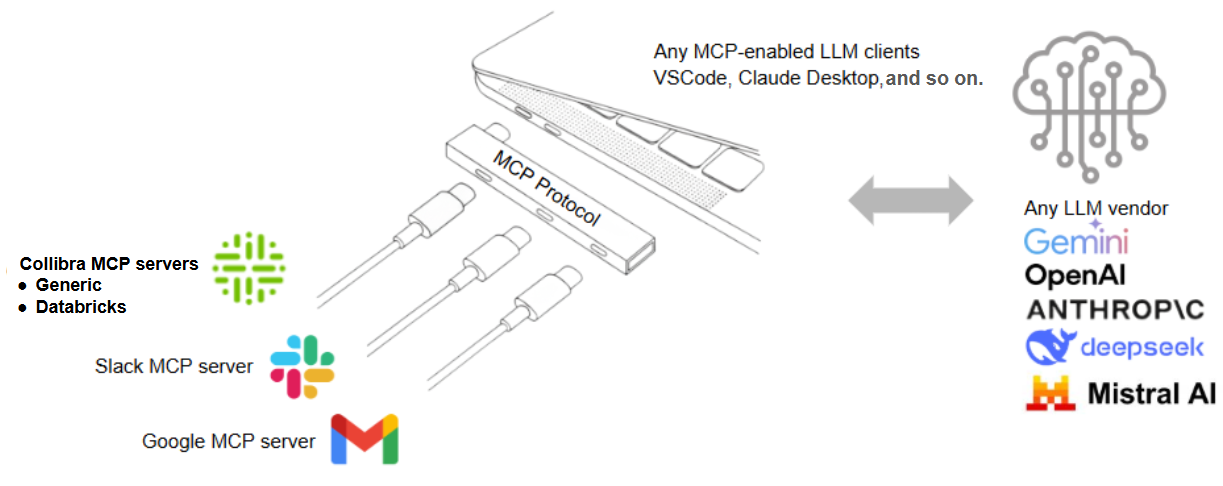
With that foundation in place, he tested the Collibra MCP, connected to an AI agent, across real governance scenarios.
"I could ask questions about data quality, metadata, lineage, business terms,... all in plain language," he says. "No switching between screens, no hunting through the interface."
One question stood out: "What's the lineage for this customer dataset, and who owns the upstream sources?"
Normally, answering this requires navigating through Collibra's interface, opening multiple assets, checking relations, and cross-referencing business glossaries. Not hard, just friction-heavy. With MCP, the answer came back immediately: full lineage, data quality scores, related business terms.
"What surprised me,apart from the speed, was the completeness. The context I'd built over months, metadata standards, quality rules, business definitions, was suddenly accessible without having to know where to look for it."
He also generated outputs directly, data lineage reports, data quality risk assessments without leaving the conversation.
"That's where it gets exciting. You're not just finding information. You're producing governance artifacts on the fly."
Challenges and Considerations
MCP is promising, but with a few challenges. Following areas need careful attention:
- Security and Access Control. "When you give an AI agent access to your governance context, you need to be deliberate about what it can see and do." MCP inherits the permissions of your underlying platforms, but teams need clear policies on what actions Agent Mode can take and who can trigger them.
- Data Quality as a Prerequisite. "MCP surfaces what's there. If your metadata is incomplete or inconsistent, that becomes visible fast." This isn't a flaw it's a feature. But it means teams need to invest in data quality before expecting MCP to deliver value.
- Trust and Adoption. "People need to trust the answers they're getting." That trust comes from accuracy, consistency, and transparency about where the information comes from. Without it, adoption stalls.
- Maturity and Skepticism. "MCP is still new and that means skepticism is natural." Not everyone is convinced yet, and that's fair. Technology needs advocates who can demonstrate real value, share early wins, and build confidence through practical examples rather than hype.
"These aren't reasons to avoid MCP, they're reasons to approach it thoughtfully. The foundation matters. We're already proving the concept with some of our clients."
Advice for Teams Starting with MCP: Build the Foundation First
"If I could give one piece of advice to teams just starting with MCP, it would be this: don't start with MCP, start with your foundations."
If your metadata is inconsistent, or your access controls are poorly defined, MCP won't solve those problems, it will highlight them faster.
From a technical perspective, treat MCP as an interface layer, not a governance layer. Your existing tools: Collibra for metadata, AWS Lake Formation for permissions,should still enforce policies and controls. MCP makes that information easier to access through natural language.
"Think of MCP like a user-friendly dashboard for your governance engine." Start with Insight Mode: let users ask questions like "Show me all datasets tagged as PII" or "What's the lineage of this report?" It's low-risk and high-value. Validate accuracy, refine the experience with a single team, then expand.
The Bigger Picture: Why Data Governance Engineering Matters
MCP is one tool among many. What matters more is the discipline behind it.
Data Governance Engineering sits at the intersection of infrastructure, policy, and user experience. It's about building systems that enforce the right rules without creating friction, systems that scale, adapt, and stay invisible until they're needed.
"The goal isto make governance disappear into the workflow. When it's done right, people don't even notice it's there: they just move faster."
Most people don't think about governance until something breaks. Arnaud wants to change that. "I want to build systems where governance is already there, working quietly, so teams can move fast without worrying."
As platforms evolve and AI becomes more embedded in data workflows, the demand for this kind of thinking is only growing. It's technical work with real organizational impact.
"We're shaping how teams interact with data. That's what makes this work interesting and why I think more people should be doing it."
Conclusion: Governance That Works for You
Our work proves that governance can be a catalyst. By integrating automation, human-centric design, and tools like MCP, teams can innovate with confidence, knowing their data is reliable, compliant, and easy to use.
"When governance is well-designed, teams can focus on what they do best without worrying about compliance."
Ready to Transform Your Data Governance? Datashift’s team of Data Governance Engineers helps leaders build practical, scalable governance that works for their teams. Let’s talk about how we can support your data initiatives.
Keep reading
Eager to learn more? No worries: we’ve got you covered.

From Human in the Loop to Human Oversight
Human-in-the-loop has become the default safety net for agentic AI: someone reviews every output, so the system must be safe. In practice that reviewer becomes the bottleneck, and the review is less reliable than we like to think. This blog makes the case for a different role for the human: oversight of the system as a whole.


AI Can Bake the Cake. But It Still Needs a Baker
We often talk about generative AI as if it's creating an entirely new way of working. But it's really the latest chapter in a transformation that many professions have experienced before. A profession close to my heart offers surprisingly a lot of valuable lessons for the future of data and functional analysts.

.png)
Data Products Need Funding. Not Projects.
Your data product strategy is not failing because of your technology. It is not failing because of your talent. It is hitting a wall because you are trying to run a product organisation on a project budget. These two models are fundamentally incompatible.