From Messy Documents to Governed Knowledge: What Our Hackathon Revealed About AI Agents

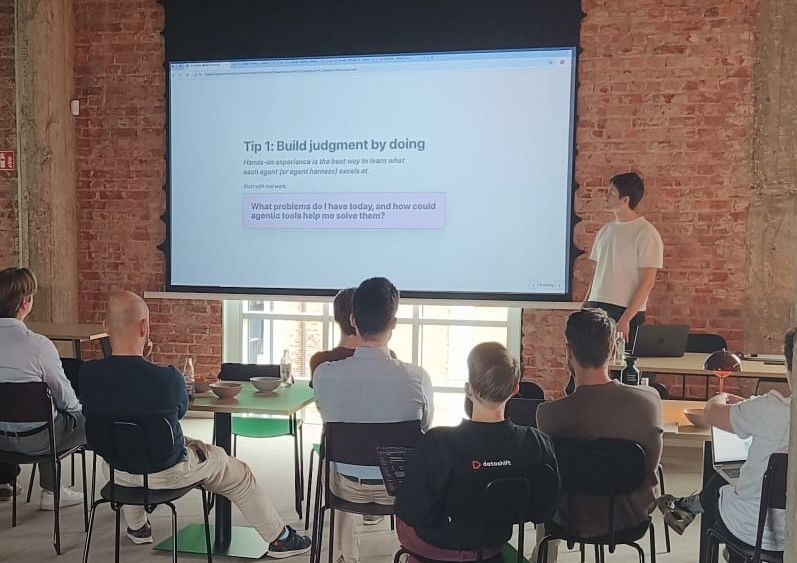
Most of an organization's knowledge lives outside structured systems: slide decks, meeting notes, contracts, feedback forms, and old project folders. This knowledge was the focus of a recent Datashift hackathon. We brought consultants together with a practical assignment: take content from previous editions of our annual bootcamp and turn it into structured, searchable, governed knowledge to help shape the next edition.
On paper, the task sounded simple. Feed the material to AI agents, let them scan and classify it, use the output to design the next curriculum faster. In practice, the exercise exposed a harder question: how do you make AI useful when the information it needs is messy and fragmented?
The capability was there, but the quality was not
The agents could store the material and find documents on a given topic. The harder challenge was classifying that material meaningfully and generating output actually useful for curriculum design. Without the right context, an agent may answer a question using an outdated document, reuse a slide that no longer reflects the company's position, or combine correct fragments into a response that sounds convincing but does not match how the organization works. The work does not disappear. It moves into review, correction, and risk management.
The missing piece: a semantic layer
Access to documents is not enough. Agents need a semantic layer that tells them how to interpret information, how to store it, and how to use it. That means defining the concepts that matter: learning objectives, trainers, target audiences, curriculum versions, and the rules that govern them. Which content is approved? Which is outdated, sensitive, or still under review?
This layer is used twice: when agents process the archive, and when they reason over that structured knowledge to generate new output. Documents stop being isolated files. They become part of an active knowledge base, connected to business context and governed by clear rules.
What we learned
Models and prompts are not enough. Agents need structure when they store information and that same structure when they reason over it later. Organizations do not need systems that generate fast answers from messy data. They need systems that turn scattered content into governed knowledge and use that knowledge to support better decisions and reliable output.
Keep reading
Eager to learn more? No worries: we’ve got you covered.

From Human in the Loop to Human Oversight
Human-in-the-loop has become the default safety net for agentic AI: someone reviews every output, so the system must be safe. In practice that reviewer becomes the bottleneck, and the review is less reliable than we like to think. This blog makes the case for a different role for the human: oversight of the system as a whole.


AI Can Bake the Cake. But It Still Needs a Baker
We often talk about generative AI as if it's creating an entirely new way of working. But it's really the latest chapter in a transformation that many professions have experienced before. A profession close to my heart offers surprisingly a lot of valuable lessons for the future of data and functional analysts.
.png)
Data Products Need Funding. Not Projects.
Your data product strategy is not failing because of your technology. It is not failing because of your talent. It is hitting a wall because you are trying to run a product organisation on a project budget. These two models are fundamentally incompatible.