From data chaos to business impact: how to tap into your invisible goldmine

.png)
Imagine if the most important information in your company was written in a language no one on your team could speak. This is the reality for most businesses today. Nearly everything that matters, like contracts, emails, strategy docs, and customer feedback, is in a format that your company’s software simply cannot read. We’ve spent decades building systems to track numbers in rows, but we’ve left the actual heart of the business buried and out of reach.
This isn't just a technical detail. It’s a fundamental language barrier between a business and its own intelligence. When 90 percent of your information is unstructured, it creates a massive "invisible" friction. It turns daily operations into a series of manual search traps and missed signals, where the more data you collect, the harder it becomes to actually know what is happening inside your own organization.
At Datashift, we do not see this chaos as a burden, we see it as your greatest untapped advantage. To unlock it, we simply need to stop treating these files as storage problems and start treating them as strategic assets. When you release the handbrake on this hidden information, the shift from operational drain to business value happens remarkably fast.
Starting With Impact: What Is Possible?
Rather than talking about data for its own sake, let us look at what happens when you put this invisible information to work in a way that every department recognizes.
Imagine a contract auditor that can audit 5,000 legal contracts in minutes instead of months. Instead of manually searching for specific liability clauses, the system instantly flags every document that deviates from your standard policy, allowing your legal team to focus only on the high priority risks.
Consider the voice of the customer: instead of guessing why churn is increasing, you can instantly analyze thousands of support tickets and chat logs to get a daily summary of the top three frustrations, backed by actual quotes, so you can fix the root cause before the next board meeting.
Or think of the instant expert, where your institutional memory becomes a searchable assistant. New hires or service technicians can ask your entire archive of project reports: "How did we solve the protocol error for this specific equipment last year?" and get a cited, accurate answer in seconds.
The Foundation: How Do We Get There?
Achieving this level of impact requires more than just an AI tool, it requires a solid data foundation built on unified sources, scalable infrastructure, and most importantly, the right input. This is where most companies hit a wall. While their structured databases are ready, the fuel for innovation: the text, the context, and the history, is hidden in unstructured data.
We help you put this data to work through two distinct paths to clarity:
1. The Search and Chat Path: If your goal is to find information across thousands of documents quickly, we use Retrieval Augmented Generation (RAG). Think of it as a research assistant who has read every document in your company and can answer questions about them in seconds, all while keeping your data exactly where it is.
2. The Structure and Enrich Path (IDP): If you need that data to feed into your CRM or ERP, we use Intelligent Document Processing. This uses AI to read your documents and extract specific data points, like invoice numbers or sentiment, turning chaos into a clean spreadsheet that enriches your existing business systems.
From Theory to Practice
We have seen these paths transform organizations by turning cluttered repositories into high performing knowledge products. In a recent project for a large scale organization, we tackled a repository of over 6,000 complex documents that were previously trapped in static formats, making them impossible to search or analyze effectively.
The process involves a smart preparation phase where documents are cleaned and organized into a format that AI can easily understand. This isn't just a basic keyword search. When a user asks a question, the system intelligently scans the entire library to find the most relevant pieces of information, combining them to provide a precise, cited answer.
This turns what was once a governance nightmare into a self updating, single source of truth. It allows organizations to move away from manual digging through folders and toward a future where every project report and contract is ready to power helpful tools like digital assistants or automated auditing systems.
Does This Sound Familiar?
Even with these proven paths, many organizations still struggle with the daily reality of hidden data. You might recognize the frustration of an employee spending 20 percent of their day digging through folders for a single clause, or the sight of a highly skilled expert stuck in a copy paste marathon because the system cannot read a scanned PDF.
Perhaps you recognize those persistent blind spots, knowing the reasons for your customer churn are buried in your logs yet remaining unable to act until it is too late. They are signs that your growth is tied to how many people you can hire to push paper, rather than how much value you can create.
If any of these scenarios sound familiar, you do not have to figure it out alone. Mastering the 90 percent of your data that is currently invisible is the ultimate competitive advantage for the next decade. Let us release the handbrake together in a safe and smart way.
Ready to Experience What Your Data Is Hiding? Reach out to talk to discover the possibilities.
Keep reading
Eager to learn more? No worries: we’ve got you covered.
.png)
Data Products Need Funding. Not Projects.
Your data product strategy is not failing because of your technology. It is not failing because of your talent. It is hitting a wall because you are trying to run a product organisation on a project budget. These two models are fundamentally incompatible.

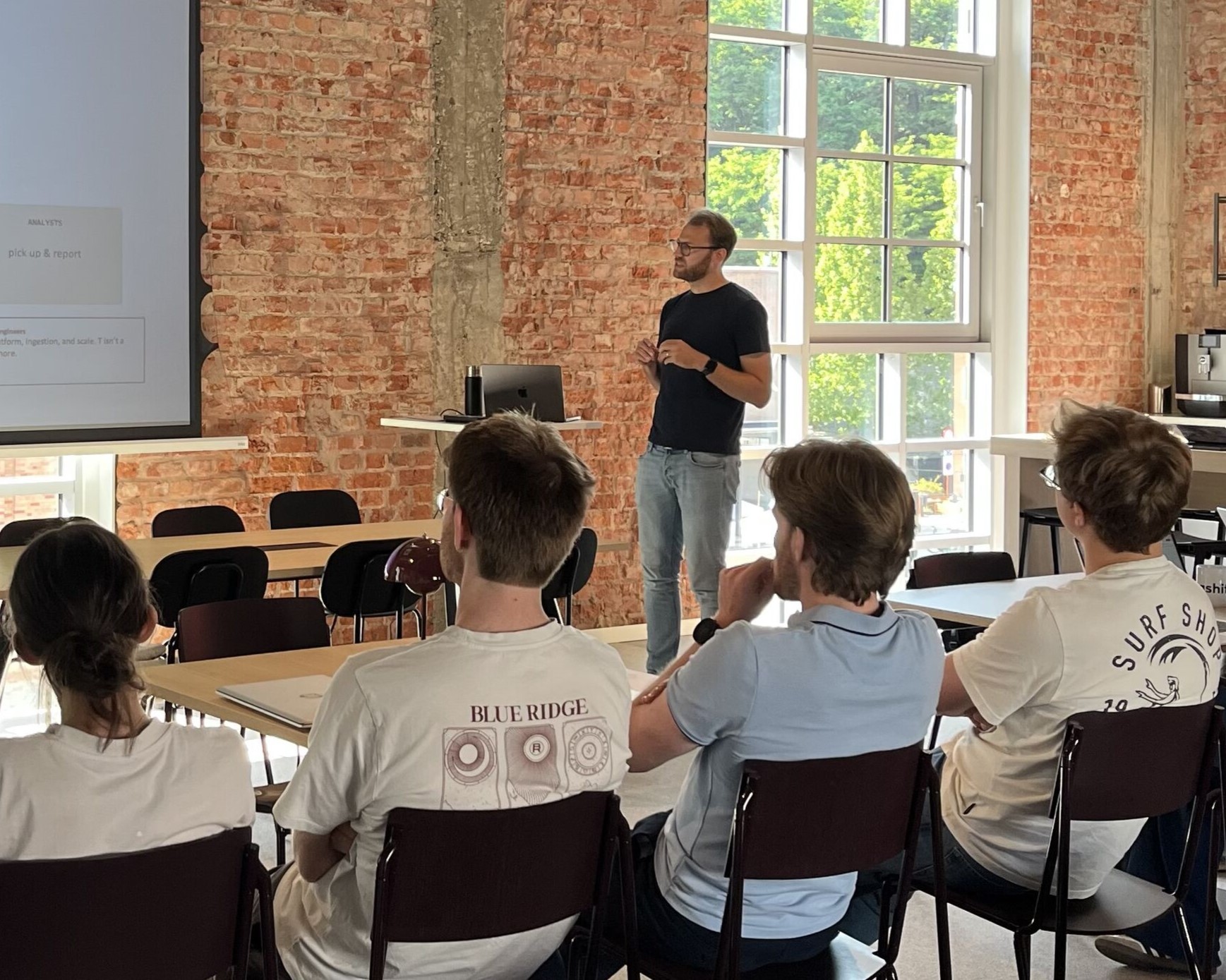
From Messy Documents to Governed Knowledge: What Our Hackathon Revealed About AI Agents
Most of an organization's knowledge lives outside structured systems: slide decks, meeting notes, contracts, feedback forms, and old project folders. This knowledge was the focus of a recent Datashift hackathon.

.png)
Centralized or Decentralized? Building a Silver Layer that does both with dbt
Most data teams are stuck choosing between consistency and speed: central control brings governance but creates bottlenecks, while domain ownership brings agility but leads to chaos. This blog explores a hybrid Silver layer that delivers both, using dbt as the framework to make it work.
.jpg)